


Ricinus communis, Euphorbiaceae
Introduction
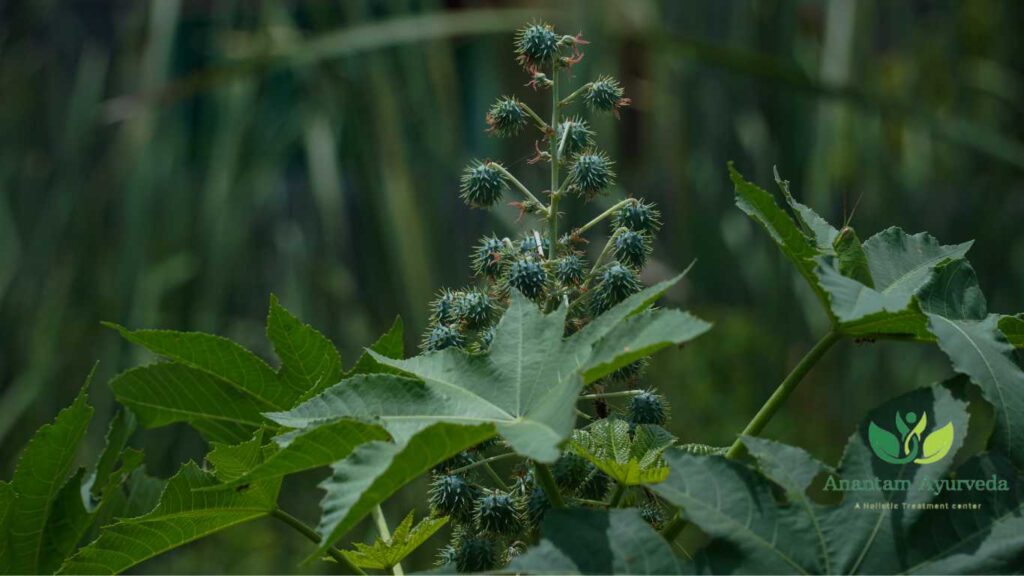
Eranda, commonly known as the Castor Plant, is one of the most important medicinal plants in Ayurveda. It is mainly valued for its strong Vata-balancing, pain-relieving, and detoxifying properties.
In Ayurvedic medicine, Eranda oil and roots are widely used in joint disorders, paralysis, digestive problems, and chronic inflammation. It is also an important ingredient in many classical Ayurvedic formulations.
Eranda, commonly known as the Castor Oil Plant, is one of the most important medicinal herbs in Ayurveda for supporting detoxification, joint comfort, digestion, hair nourishment, and overall wellness. Scientifically identified as Ricinus communis, Eranda has been traditionally used for centuries in Ayurvedic medicine for its powerful cleansing, lubricating, and Vata-balancing properties.
Ayurveda especially values Eranda for managing disorders related to Vata dosha, including joint stiffness, muscular discomfort, dryness, constipation, and nervous imbalance. The plant’s seeds, roots, leaves, and especially castor oil are widely used in both internal and external Ayurvedic therapies.
Eranda is traditionally beneficial for:
- Detoxification and bowel cleansing
- Joint and muscular support
- Digestive wellness
- Hair and scalp nourishment
- Skin moisturization
- Swelling and stiffness
- Vata imbalance disorders
Castor oil extracted from Eranda seeds is one of the most widely used Ayurvedic oils for promoting bowel regularity, lubricating body tissues, supporting healthy scalp function, and relieving stiffness through massage therapies.
Modern herbal studies suggest that Ricinus communis contains ricinoleic acid, fatty acids, flavonoids, antioxidants, and anti-inflammatory compounds that support many of its traditional therapeutic applications.
Purification of Eranda seeds
Eranda seeds (Ricinus communis) are highly toxic due to the presence of a potent toxin called ricin, making their purification essential before any medicinal use in Ayurveda. The traditional purification process involves fomenting the seeds in coconut water for about three hours, which helps in neutralizing the toxicity and softening the outer seed coat. After this, the seeds are thoroughly washed with clean water to remove residual toxins and then shade-dried to preserve their medicinal qualities. In some practices, the outer shell is removed after purification to use only the inner kernel.
Special note about Ricinus communis
Seeds of this plant are highly toxic due to the presence of chemical compound ricin. It is the most poisonous plant in the world. In adults, the fatal dose is considered to be about 5-10 seeds. Overdose may cause nausea, vomiting, diarrhea, hypotension, tachycardia, seizures and it may lead to spontaneous death. Symptoms may begin in 2-4 hours or it may be delayed for 36 hours. Ricin is also used in the preparation of various insecticides and pesticides.
According to Acharya Charak:-
एरण्डमूलं वृष्यवातहराणाम्॥ (च.सू २५)
From all the herbs which have the capability for pacifying vata dosha and are aphrodisiac in nature, eranda is the best.
Names
- Latin Name – Ricinus Communis
- Hindi Name – Erand, Redi, Erend
- English Name – Castor, African Coffee Tree, Arandi
- Bengali Name – Rehri, Bhairenda
- Telugu Name – Amudamu
- Bengali Name – Bherenda, Rehri, Bhaerand
- Tamil Name – Amanakku, Amanakkam
- Marathi Name – Erandi
- Malayalam Name – Avanakku
- Gujarati Name – Diveligo, Diveli Erandi
- Kannada Name – Haralu, Manda
- Farsi Name – Bed Anjeer
- Arabian Name – Khirva
- Assam Name – Eri
- Nepali Name – Areta, Orer
- Punjabi Name – Aneru, Arand
- Chinese Name – Pee – Ma
- Egyptian Name – Kiki
- Sinhala Name – Endaru
- Persian Name – Ved Anjir
Effects on Doshas
It balances Vata and Kapha doshas.
| Charak Samhita | Sushrut Samhita |
| Behdniya – Herbs used for purgation.Angmarda prashmana – Herbs which are good for relieving body aches.Svedopaga – Herbs which are good for sweating. | Vidarigandhadi, Adhobhaghara, vata sanshamana |
The Ancient Verse about Erand (Ricinus communis)


Botanical Description of Eranda
🔹 Scientific Classification
- Scientific Name: Ricinus communis
- Family: Euphorbiaceae
- Common Names: Eranda, Castor Plant, Castor Oil Plant
- Plant Type: Perennial shrub or small tree
General Habit of the Plant
Eranda is a fast-growing medicinal shrub widely cultivated in tropical and subtropical regions. The plant is known for its:
- Large ornamental leaves
- Thick hollow stems
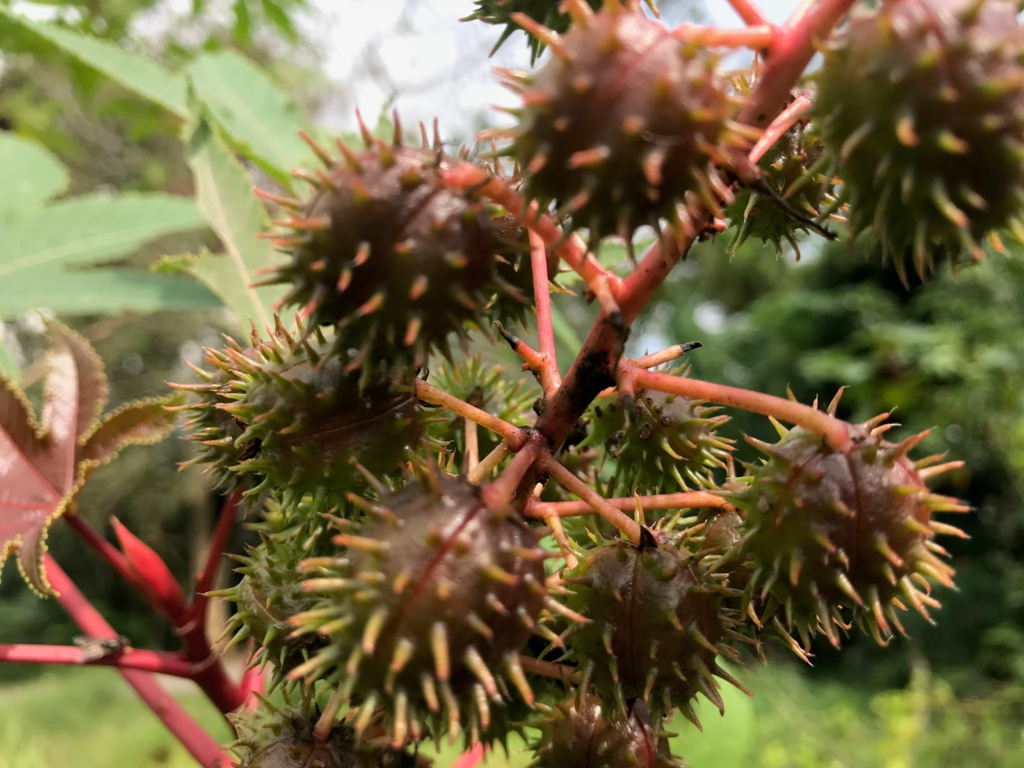
- Spiny fruits
- Oil-rich seeds
It can grow as a shrub or small tree depending on climate and soil conditions.
Root System
- Strong taproot system
- Deep penetrating roots
- Well-developed lateral branches
The root system helps the plant tolerate dry conditions effectively.
Stem
- Thick, hollow, and soft when young
- Green, reddish, or purple-colored stem
- Becomes woody with maturity
Stem Characteristics:
- Smooth surface
- Branched growth habit
- Rapid growth rate
Mature stems become sturdy and support large leaves and fruits.
Leaves of Eranda
- Large palmate (star-shaped) leaves
- Broad spreading structure
- Long leaf stalks (petioles)
Leaf Characteristics:
- Green, reddish-green, or purple shades
- Smooth glossy surface
- Deeply divided lobes
Leaves are one of the easiest identifying features of the plant.
Flowers of Eranda
- Small yellowish-green flowers
- Male and female flowers present on the same plant
- Flowers grow in upright clusters
Flowering Season:
- Mostly during warm and rainy seasons
Female flowers usually appear at the upper portion of the flower cluster.
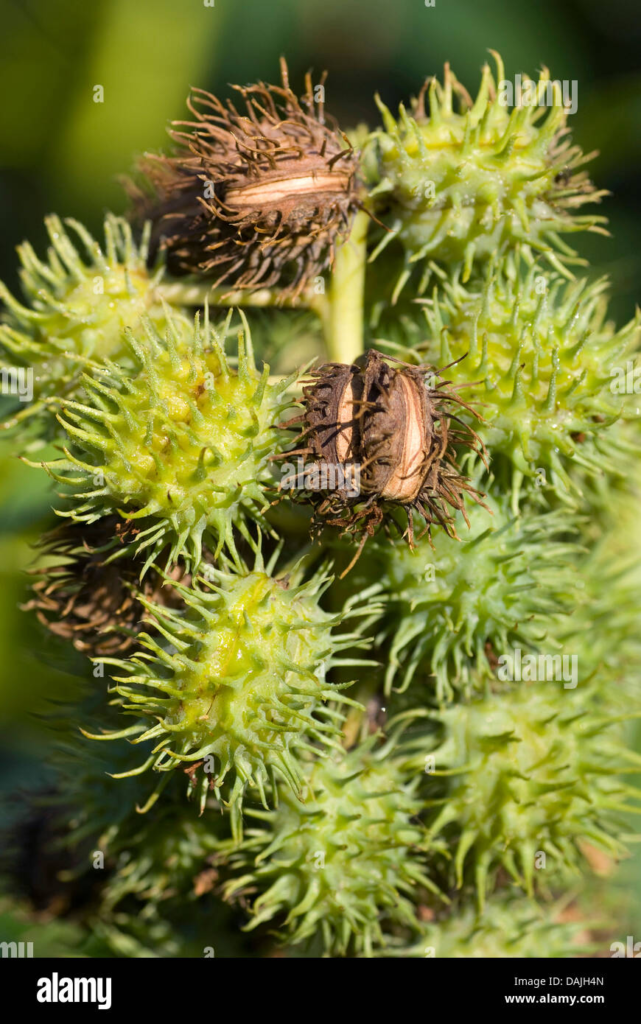
Fruits of Eranda
🔸 Fruit Characteristics
- Spiny or smooth seed capsules
- Green when immature
- Brownish on maturity
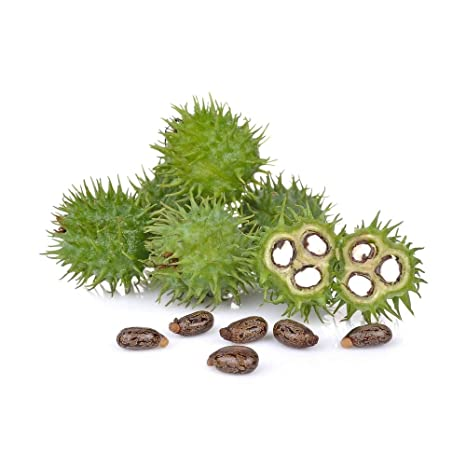
- Three-chambered fruit structure
Each fruit capsule contains multiple seeds.
Seeds
- Oval and shiny seeds
- Brown, gray, black, or mottled appearance
- Rich in castor oil
Seed Features:
- Hard outer covering
- Smooth glossy texture
Raw seeds are toxic and should never be consumed directly.
Habitat & Distribution
Eranda naturally grows in:
- India
- Africa
- Mediterranean regions
- Tropical and subtropical areas worldwide
Commonly found in open fields, roadsides, and cultivated lands.
Preferred Growing Conditions
🔹 Climate
- Warm tropical and subtropical climates
- Moderate rainfall preferred
🔹 Soil
- Well-drained fertile soil
- Sandy or loamy soil suitable
🔹 Sunlight
- Full sunlight required for healthy growth
The plant grows rapidly under warm sunny conditions.
Growth & Lifecycle
- Plant Type: Perennial shrub/small tree
- Growth Rate: Fast-growing
- Propagation: Mainly through seeds
- Lifespan: Several years under suitable conditions
Plants may grow very tall in fertile environments.
Special Botanical Features
- Large star-shaped leaves
- Oil-rich medicinal seeds
- Hollow thick stems
- Spiny fruit capsules
- Fast-growing medicinal shrub
Identification in Nature
Eranda can generally be identified by:
- Large palmate leaves
- Thick hollow stems
- Spiny seed capsules
- Glossy mottled seeds
The combination of broad leaves and spiny fruits makes identification easy.
Important Botanical Note
Although Ricinus communis is highly valued in Ayurveda, raw seeds naturally contain toxic compounds such as ricin and should never be consumed directly without proper processing.
Summary
Eranda (Ricinus communis) is a fast-growing medicinal shrub recognized for its large star-shaped leaves, oil-rich seeds, and powerful Ayurvedic value. Traditionally used for detoxification, joint support, digestion, hair nourishment, and Vata balance, Eranda remains one of the most important medicinal plants in Ayurvedic healthcare naturally.
Ayurvedic Properties of Eranda
Overview in Ayurveda
Ricinus communis, commonly known as Eranda, is one of Ayurveda’s most important herbs for supporting detoxification, joint comfort, digestion, lubrication, and Vata balance. The plant and especially its oil (Eranda Taila) are highly valued in Ayurvedic medicine for their cleansing, warming, and nourishing actions.
Ayurveda primarily uses Eranda in conditions involving:
- Constipation
- Joint stiffness
- Muscular discomfort
- Dryness
- Swelling
- Vata imbalance
Its strong lubricating and cleansing properties make Eranda especially beneficial in therapies aimed at removing accumulated toxins (Ama) and restoring proper movement and flexibility in the body.
🔹 Rasa (Taste)
Eranda possesses:
- Madhura (Sweet)
- Katu (Pungent)
- Kashaya (Astringent)
Ayurvedic Significance:
These tastes help:
- Support cleansing and detoxification
- Reduce Vata imbalance
- Improve bowel movement
- Promote tissue nourishment
Pungent and astringent qualities assist in clearing stagnation.
🔹 Guna (Qualities)
- Guru (Heavy)
- Snigdha (Unctuous/Oily)
- Tikshna (Sharp/Penetrating)
Ayurvedic Significance:
These qualities help:
- Lubricate dry tissues
- Improve bowel evacuation
- Reduce stiffness and rigidity
- Penetrate deeply into tissues
Particularly beneficial in dry Vata disorders.
🔹 Virya (Potency)
- Ushna Virya (Hot/Warming Potency)
Benefits:
- Improves circulation
- Reduces coldness and stiffness
- Supports digestion and elimination
- Helps calm aggravated Vata
Warming nature makes Eranda highly effective in Vata-related joint disorders.
🔹 Vipaka (Post-Digestive Effect)
- Madhura Vipaka (Sweet post-digestive effect)
Benefits:
- Supports tissue nourishment
- Maintains lubrication and strength
- Promotes rejuvenation after cleansing
Balances the strong cleansing action with nourishment.
🔹 Dosha Effect
Helps Balance:
- Vata
May increase:
- Pitta (in excessive use)
Particularly useful in:
- Dryness
- Constipation
- Joint stiffness
- Muscular discomfort
One of Ayurveda’s best herbs for aggravated Vata conditions.
Main Ayurvedic Actions of Eranda
🔸 Virechana
Traditionally used for:
- Therapeutic purgation
- Detoxification
- Removal of accumulated toxins (Ama)
Castor oil is widely used in Ayurvedic cleansing therapies.
🔸 Vatahara
Supports:
- Reduction of Vata imbalance
- Joint flexibility
- Nervous system balance
🔸 Shothahara
Traditionally helps reduce:
- Swelling
- Inflammatory discomfort
- Tissue stiffness
🔸 Vedanasthapana
Supports:
- Joint comfort
- Muscular relaxation
- Relief from stiffness and pain
🔸 Bhedana
Helps:
- Relieve bowel obstruction
- Promote healthy elimination
Effect on Agni (Digestive Fire)
Eranda helps:
- Stimulate digestion
- Improve bowel movement
- Reduce toxin accumulation
Particularly useful in sluggish digestion associated with Vata imbalance.
Role in Detoxification
Eranda is widely used in Ayurveda for:
- Colon cleansing
- Eliminating Ama (toxins)
- Supporting detox therapies (Shodhana)
Castor oil is commonly used in Panchakarma preparations.
Role in Joint & Muscle Wellness
Traditionally beneficial for:
- Arthritis support
- Joint stiffness
- Sciatica-related discomfort
- Muscular tightness
Warm castor oil massage is a common Ayurvedic practice.
Effect on Vata Disorders
Eranda is especially valued in:
- Dryness
- Constipation
- Nervous imbalance
- Stiffness and restricted movement
Helps restore lubrication and smooth movement in the body.
Effect on Dhatus (Body Tissues)
Supports:
- Mamsa Dhatu (muscle tissue)
- Asthi Dhatu (bone tissue)
- Majja Dhatu (nervous tissue)
Nourishes tissues while promoting detoxification.
Effect on Srotas (Body Channels)
Supports:
- Annavaha Srotas (digestive channels)
- Purishavaha Srotas (excretory channels)
- Asthivaha Srotas (bone and joint channels)
Helps maintain proper movement and elimination.
Traditional Ayurvedic Uses
Eranda is traditionally used for:
- Constipation
- Joint discomfort
- Arthritis support
- Sciatica
- Swelling and stiffness
- Hair and scalp nourishment
- Dry skin support
Important Ayurvedic Precautions
Raw seeds of Ricinus communis are toxic and should never be consumed directly.
Excessive use may cause:
- Loose motions
- Dehydration
- Abdominal discomfort
- Excess body heat
Use cautiously in:
- Pregnancy
- Severe weakness
- Chronic diarrhea
Therapeutic use should be guided by qualified practitioners.
Traditional Ayurvedic Preparations
Eranda is commonly used in:
- Eranda Taila (Castor Oil)
- Vatahara oils
- Panchakarma detox therapies
- Joint support formulations
Summary
Ricinus communis is a powerful Ayurvedic herb traditionally valued for supporting detoxification, digestion, joint comfort, lubrication, hair nourishment, and Vata balance. Its warming, penetrating, and unctuous properties make it especially beneficial in dryness, stiffness, constipation, and Vata-related disorders.
When used properly and under Ayurvedic guidance, Eranda may help maintain healthy elimination, flexible joints, nourished tissues, balanced digestion, and overall wellness naturally.
Health Benefits of Eranda
1. Best Herb for Joint Pain and Arthritis
Eranda is highly beneficial in:
- Arthritis
- Back pain
- Sciatica
- Knee pain
- Joint stiffness
Castor oil massage reduces pain and improves mobility.
2. Helps in Paralysis and Nerve Disorders
Eranda strengthens nerves and muscles. It is used in:
- Facial paralysis
- Weak limbs
- Nervous weakness
- Muscle stiffness
3. Improves Digestion and Relieves Constipation
Castor oil works as a natural laxative and helps in:
- Chronic constipation
- Gas and bloating
- Weak digestion
- Intestinal cleansing
4. Reduces Swelling and Inflammation
Eranda has strong anti-inflammatory properties. It helps in:
- Joint swelling
- Muscle inflammation
- Gout
- Edema
5. Supports Detoxification
Eranda helps remove toxins from the body through controlled purgation therapy in Ayurveda (Virechana).
6. Improves Skin and Hair Health
Castor oil is useful for:
- Dry skin
- Cracked heels
- Hair fall
- Dandruff
- Eyebrow and eyelash growth
7. Supports Reproductive and Postnatal Health
In traditional practice, Eranda oil is sometimes used for uterine cleansing and postnatal recovery under supervision.
Conclusion
Eranda, scientifically known as Ricinus communis, is one of Ayurveda’s most powerful herbs for supporting detoxification, digestion, joint comfort, hair nourishment, and Vata balance. Its warming, lubricating, and cleansing properties make it especially valuable in traditional Ayurvedic therapies for constipation, stiffness, swelling, dryness, and muscular discomfort.
Ayurveda highly values Eranda for its ability to promote healthy elimination, remove accumulated toxins (Ama), improve flexibility, and nourish body tissues. Castor oil derived from the plant is widely used both internally and externally for bowel cleansing, joint massage, scalp nourishment, and skin moisturization.
With its strong Vata-balancing action and rejuvenating qualities, Eranda continues to hold an important place in Ayurvedic wellness practices. When used properly and under appropriate guidance, it may help maintain healthy digestion, comfortable joints, nourished hair, proper detoxification, and overall long-term wellness naturally.
